Friday, July 31, 2009

Top Stories of the World

South Africa: City workers end weeklong strike

ohannesburg: Labor leaders in South Africa say a strike by municipal worker is over.

Mthandeki Nhlapo, general secretary of the 150,000-member South African Municipal Workers' Union, said on Friday that garbage collectors, zoo keepers, bus drivers and other city workers would be back on the job on Monday.

The union accepted a 13 per cent wage increase after initially demanding 15 per cent. Nhlapo said the increase and provisions such as improved housing allowances are "a significant victory."

The workers have held marches since going on strike on Monday, at times littering streets, looting shops and threatening non-strikers.

The disruption in city services had led volunteers to pitch in at Johannesburg's zoo, sweeping out enclosures and chopping fruits and vegetables for animals' meals.

UN: Sharp rise in Afghan deaths

The civilian death toll in Afghanistan has risen by 24 per cent this year, the United Nations has said.

In a new report released on Friday, the UN Assistance Mission in Afghanistan (UNAMA) blamed bombings by the Taliban and air raids by international forces for the majority of the killings.

The report said that 1,013 civilians were killed on the sidelines of their country's armed conflict from January to the end of June, compared to 818 in the first half of 2008 and 684 in the same period in 2007.

Commenting on the report, Navi Pillay, the UN high commissioner for human rights, said it was critical that steps be taken to shield Afghan communities from fighting.

"All parties involved in this conflict should take all measures to protect civilians, and to ensure the independent investigation of all civilian casualties, as well as justice and remedies for the victims," Pillay said.

In video

Afghanistan's spiralling civilian deaths

James Bays, Al Jazeera's correspondent in Afghanistan, said: "This new report will be deeply controversial here. For many Afghans, this is a key political issue.

"The line that's coming from the International Security Assistance Force (Isaf) and the US and their new commander here, General [Stanley] McChrystal, is that the success of their mission is not about killing Taliban, it's about the number of Afghans who feel they are being protected."

Erica Gaston, from the Open Society Institute in Afghanistan, agreed and told Al Jazeera that "civilian casualty losses colour Afghan impressions of international forces and the Afghan government".

"Afghan people want protection and they want stability and if the international forces and Afghan government can't deliver that, then they will turn to other political leaders," she said.

Grim assessment

In its grim assessment of the first half of 2009, the UNAMA said the Taliban and other anti-government fighters have become more deadly by shifting from ambush attacks to suicide bombings, roadside explosives and targeted assassinations.

It warned that more civilians would likely be killed as anti-government fighters try to battle a troop increase by the administration of Barack Obama, the US president, and seek to destabilise the country before presidential and provincial council elections on August 20.

The UN said Taliban fighters were hiding in civilian areas to confuse security forces [AFP]

Attacks on government and international forces are "frequently undertaken regardless of the impact on civilians in terms of deaths and injuries, or destruction of civilian infrastructure," the 21-page report said.

The US and Western powers have also become more deadly, partly because anti-government fighter groups are taking cover in residential areas or luring US-led forces into unintentionally killing civilians, the report said.

The Taliban and others are "basing themselves in civilian areas so as to deliberately blur the distinction between combatants and civilians, and as part of what appears to be an active policy aimed at drawing a military response to areas where there is a high likelihood that civilians will be killed or injured".

The report said international forces have given high priority to minimising civilian casualties, but along with Afghan forces have killed 310 civilians.

Space shuttle lands in Florida

The US space shuttle Endeavour landed safely at the Kennedy Space Center in Florida this afternoon after a successful mission to the International Space Station.

The shuttle and its seven-member crew left orbit for the Florida landing after a 16-day mission to complete Japan's International Space Station laboratory.

Endeavour spent 11 days at the orbiting outpost, where astronauts installed the final segment of Japan's $2.4 billion Kibo laboratory.

Flying 200 miles (320 km) over the Indian Ocean, commander Mark Polansky and pilot Douglas Hurley fired Endeavour's twin braking rockets at 9.41am EDT (1341 GMT) to slow the ship and begin an hour-long glide through the atmosphere.

During an 11-day stay at the station, Endeavour's crew installed a Japanese-built platform for telescopes and other science experiments. They also delivered spare parts and replaced batteries to keep the solar-powered station running during night-time passes around Earth.

Nasa is stocking the $100 billion station, a project of 16 nations, in preparation for the shuttle fleet's retirement next year after seven more missions.

Using a Japanese-built robot arm for the first time, astronauts placed three devices on the new platform: an X-ray telescope, a monitor to measure electromagnetic fields around the station and a communications antenna for a Japanese satellite network.

One of the Endeavour astronauts, rookie Timothy Kopra, remained behind on the space station, taking over the flight engineer's post previously held by Japan's Koichi Wakata, who returns home aboard the shuttle after 4 1/2 months in orbit.

Musharraf emergency 'unlawful'

Pakistan's Supreme court has ruled that emergency rule enforced by former President Pervez Musharraf was unconstitutional and illegal.

The order clears the way for him to be tried for treason because under the constitution, anyone found guilty of abrogating it can be prosecuted.

The court ruling also said that the appointment of judges after the emergency was illegal.

However, the order will not affect the position of President Asif Ali Zardari.

It said that questions over the constitutional legitimacy of his appointment should be "exempted".

The court ruled that if this matter was brought before it, there was a danger Pakistan could be plunged into another constitutional crisis.

But the ruling does mean that those judges who were appointed after the emergency was imposed could lose their jobs.

Wall Street rises on mixed GDP report

NEW YORK: US stocks rose Friday as the market digested a government report on second-quarter US output that showed a smaller contraction than

expected but weakness in consumer spending.

The Dow Jones Industrial Average rose 43.23 points (0.47%) to 9,197.69 at 1457 GMT, as the market extended gains from a rally Thursday.

The technology-heavy Nasdaq composite gained 9.70 points (0.49%) to 1,994.00 and the Standard & Poor's 500 broad-market index advanced 3.48 points (0.35%) to 990.23.

The Commerce Department reported before the market open that the world's biggest economy had narrowed its contraction to an annualized rate of 1.0% in the second quarter.

The average analyst forecast was for a sharper 1.5% contraction in the department's first estimate for the April-June quarter gross domestic product.

"It seems that this less-bad nominal report is not doing anything for stocks," said Jon Ogg at 24/7WallSt.com.

Despite the slower pace of contraction, after a revised 6.4% decline in the first quarter, the Street reaction "was one of disappointment," said Patrick O'Hare of Briefing.com.

"This disappointment was a reminder that the economic recovery will be an uneven affair, quite simply because the US consumer isn't what he/she used to be in the face of rising unemployment and falling home values," O'Hare said.

Government spending was a main driver of the expansion but consumer spending, which accounts for about two-thirds of economic activity, fell 1.2% after a rise of 0.6% in the first quarter.

Jennifer Lee, an analyst at BMO Capital Markets, was upbeat on what she said was the largest improvement in the economy since 2000.

"The results set the stage for a positive read on the GDP in the third quarter, which means that the recession will likely be wrapped up in the July-to-September period," Lee said.

Bomb attacks put resorts on high alert

PALMA DE MALLORCA - Spain's security forces were on maximum alert Friday for the 50th anniversary of the armed Basque group ETA, blamed for bombings that killed two police officers and injured scores of people this week.

ETA was founded on July 31, 1959, and has killed more than 825 people since beginning its violent campaign for an independent Basque state in 1968.

Authorities blame ETA for two attacks this week - an explosion that killed two officers near a police barracks on Mallorca island on Thursday and a car bomb that injured more than 60 people in the northern city of Burgos on Wednesday.

If confirmed as ETA attacks, the blasts would conflict with government assertions that the group is seriously weakened after major police crackdowns in Spain and France in recent years.

Their timing, two days before the milestone anniversary, may be part of an ETA effort to demonstrate it is in no danger of breaking up.

"The government has given orders to the security forces to be on maximum alert, to double their work, to increase even more their efforts and to protect themselves from these vile murderers," Prime Minister Jose Luis Rodriguez Zapatero said late Thursday.

Black cop at Gates home regrets ‘Uncle Tom’ label

CAMBRIDGE — A black sergeant who was at the home of Harvard scholar Henry Louis Gates Jr. when he was arrested says he’s been maligned as an "Uncle Tom" for supporting the actions of the white arresting officer.

Cambridge Sgt. Leon Lashley gave a letter to Sgt. James Crowley to give to President Barack Obama during their so-called "beer summit" with Gates on Thursday night at the White House.

In the letter, which was also sent to CNN, Lashley says Gates "may have caused grave and potentially irreparable harm to the struggle for racial harmony."

Lashley says he has become known as a traitor to his heritage by some because he "spoke the truth" about the arrest.

Gates was charged with disorderly conduct by police investigating a burglary. The charge was later dropped.

Vatican protests as Italy approves use of abortion pill

• Users will excommunicate themselves, officials say
• Berlusconi government quiet on sexual ethics

The Vatican and Catholic politicians today reacted with dismay to a decision by Italy's drugs agency to approve limited use of the abortion pill Mifepristone, which has been available in much of the rest of Europe since the 1990s.

Senior Vatican officials said women who took the pill would be excommunicating themselves, as would doctors who prescribed it and nurses who administered it. Because of the high proportion of conscientious objectors to abortion in the Italian health service – some 70% – it is likely that use of the pill will be circumscribed.

After a reportedly heated four-hour session that ended late on Thursday, the board of the Italian pharmaceuticals agency, AIFA, voted by four to one to approve Mifepristone. But it stipulated that the pill should only be administered in hospital during the first seven weeks of pregnancy.

Also known as RU-486, Mifepristone had already been in use in some Italian regions on a trial basis.

Archbishop Rino Fisichella, head of the pope's thinktank on bioethical issues, the Pontifical Academy for Life, said: "The fact of taking a pill may be less traumatic for a woman, but it does not change the substance. It is still abortion."

He added that the consequences for a Catholic – automatic excommunication – were "the same as those for surgical abortion". To the continuing dismay of the Vatican, abortion has been available on demand in Italy since 1978, though usually only in the first 90 days of pregnancy.

For Silvio Berlusconi's government and its supporters, this was a delicate moment for any announcement bearing on sexual ethics. Recordings purportedly made by a prostitute who claims that she spent the night with Italy's 72-year-old married prime minister have focused public attention on his own apparently wide-ranging sex life. In one, a businessman who allegedly supplied women for parties at Berlusconi's home can be heard warning one of them that the prime minister never uses a condom.

Berlusconi had no immediate comment to make on the agency's decision. The reaction of other Italian politicians cut across party boundaries, though most of the censure came from the right, dominated by the governing Freedom People movement (PdL).

A spokeswoman for Rome's formerly neo-fascist mayor, Gianni Alemanno, a leading member of the PdL, said: "Infanticide is, in fact, being legalised for the modest sum of €14 a tablet." But a minister in Berlusconi's cabinet, Stefania Prestigiacomo, said she endorsed the use of Mifepristone "under control in a hospital".

Livia Turco, health minister in the previous, centre-left government when the trials began two years ago, said the drug had been subjected to a "rigorous investigative process during which the medical aspects and the compatibility of [Mifepristone] with Italian legislation were scrupulously evaluated". But Paola Binetti, a member of the same party, sharply criticised the approval of what she termed "do-it-yourself abortion".

Mifepristone has other medical uses and can be used as an emergency contraceptive if taken after sex but before ovulation. Its active compound was discovered by French researchers in 1980. The drug is marketed in the United States as Mifeprex and in the rest of the world as Mifegyne. The drug is not legal in Ireland or Poland.

No Apologies From the Boss of a No-Frills Airline

LONDON

MICHAEL O’LEARY, chief executive of the European budget airline Ryanair, was discussing his new scheme to charge passengers to go to the bathroom.

Most passengers — the “discretionary toilet visitors,” as he calls them — would eventually forgo in-flight bathroom use altogether, he predicted. Which is good, because he would also like to reduce the number of bathrooms per plane, to one.

What if the plane was stricken by some nasty effluent illness, like food poisoning?

A snorting noise wafted over from the chair where Mr. O’Leary was sitting. “We don’t serve enough food for everybody to get food poisoning,” he said.

At 48, the quick-talking, blue jean-wearing Mr. O’Leary is one of the most successful businessmen in Ireland, presiding over an airline that is, remarkably, flourishing in a brutal climate for airlines (and most other businesses). He is known for thick-skinned aggression, outrageous public statements and an implacable belief that short-haul airline passengers will endure nearly every imaginable indignity, as long as the tickets are cheap and the planes are on time.

“Soon he’ll be charging us for oxygen and number of limbs,” the Sun newspaper groused in June, when Mr. O’Leary unveiled his latest proposal — getting people to carry their own bags to the plane.

Mr. O’Leary revels in his persona as national pugilist and provocateur, alternately charming and offending.

He once dressed as the pope to advertise Ryanair’s new route from Dublin to Rome. He has declared that fat people should pay more for their seats, but that it would take too long to weigh them at the airport. And, at a news conference to discuss the possibility of starting trans-Atlantic flights, he suggested — to the consternation of the young woman gamely translating his remarks into German — that business-class customers would receive free oral sex. http://www.youtube.com/watch?v=UfIY24BErBE

Mr. O’Leary might sometimes seem like a stand-up comedian throwing out insane suggestions for their shock value. In private, he is known as a tough negotiator whose canny timing, draconian demands and sharp elbows helps him extract favorable deals, as when he put in a huge order for new planes when the market had collapsed, after Sept. 11.

His avowed enemies include unions (his workers are not unionized), politicians who impose airport taxes, environmentalists, bloggers who rant about poor service, travel agents, reporters who expect free seats, regulators who thwart his plans and airport owners like BAA, whom he once called “overcharging rapists.”

There is method in all this, it seems. Insulting, or, “slagging off,” as they say here, “the BAA and the British government and the rest is all designed to send strong signals to everyone who deals with Ryanair that you’re not going to get away with anything,” said Joe Gill, director of equity research at Bloxham Stockbrokers in Dublin.

Ryanair flies more than 850 routes across Europe, often to obscure airports far away from big cities — “from nowhwere to nowhere,” in the scoffing words of Sir Stelios Haji-Ioannou, who runs the competing airline EasyJet. Ryanair’s post-tax profits fell by 78 percent in the year ending this March, but it still made a 105 million euros in profit. While most carriers are hemorrhaging passengers, Ryanair expects its passenger numbers to increase, to 68 million this year from 57 million in 2008.

The mystery is why so many people are willing to put up with an airline that, in the words of The Economist, “has become a byword for appalling customer service, misleading advertising claims and jeering rudeness towards anyone or anything that gets in its way.”

“Nobody helps you — it’s as simple as that,” said Malcolm Ginsberg, editor in chief of the travel newsletter aerbt.co.uk, describing what happens to Ryanair passengers who need assistance at the airport.

That is not the point, Mr. O’Leary said in a recent interview. “Our customer service is unlike every other airline, which has this image of, ‘We want to fall down at your feet and you can walk all over us and the customer is always right’ and all that nonsense.”

He was sitting in a cafĂ© at the chamber of commerce here, drinking coffee. Soon, he would hold a news conference where, among other things, he would call Prime Minister Gordon Brown a “twit” and a “Scottish miser.”

By contrast, Mr. O’Leary continued, Ryanair promises four things: low fares, a good on-time record, few cancellations, and few lost bags.

“But if you want anything more — go away! Will we put you in a hotel room if your flight was canceled?” Mr. O’Leary asked rhetorically. “No! Go away.”

He began riffing on the theme of when Ryanair grants refunds, which is never.

House Votes for $2 Billion Fund to Extend ‘Clunker’ Plan

WASHINGTON — The House of Representatives voted to provide an emergency $2 billion for the “cash for clunkers” program on Friday, and the White House declared the program very much alive, even though car buyers appear to have already snapped up the $1 billion that Congress originally appropriated.

Wednesday, July 29, 2009

Military planning for possible H1N1 outbreak

WASHINGTON (CNN) -- The U.S. military wants to establish regional teams of military personnel to assist civilian authorities in the event of a significant outbreak of the H1N1 virus this fall, according to Defense Department officials.

The proposal is awaiting final approval from Defense Secretary Robert Gates.

The officials would not be identified because the proposal from U.S. Northern Command's Gen. Victor Renuart has not been approved by the secretary.

The plan calls for military task forces to work in conjunction with the Federal Emergency Management Agency. There is no final decision on how the military effort would be manned, but one source said it would likely include personnel from all branches of the military.

It has yet to be determined how many troops would be needed and whether they would come from the active duty or the National Guard and Reserve forces.

Civilian authorities would lead any relief efforts in the event of a major outbreak, the official said. The military, as they would for a natural disaster or other significant emergency situation, could provide support and fulfill any tasks that civilian authorities could not, such as air transport or testing of large numbers of viral samples from infected patients.

As a first step, Gates is being asked to sign a so-called "execution order" that would authorize the military to begin to conduct the detailed planning to execute the proposed plan.

Orders to deploy actual forces would be reviewed later, depending on how much of a health threat the flu poses this fall, the officials said.

Blue Dogs say they've reached a compromise on health care

(CNN) -- A group of fiscally conservative House Democrats announced Wednesday they reached a deal with the chamber's Democratic leaders on a health care reform bill.

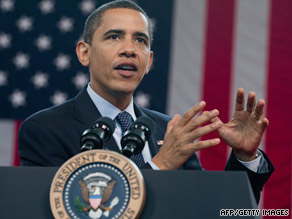
President Obama stresses the urgency of health care reform at a town hall meeting in Raleigh, North Carolina.

President Obama stresses the urgency of health care reform at a town hall meeting in Raleigh, North Carolina.

Rep. Mike Ross of Arkansas, speaking for the Blue Dog Democrats on the House Energy and Commerce Committee, said the agreement calls for the panel to begin debating the bill later Wednesday but for no vote by the full House until after the upcoming August congressional recess.

Ross and the Blue Dogs had threatened to derail the bill in the committee because of concerns that it costs too much and failed to address systemic problems in the nation's ailing health care industry.

The Energy and Commerce Committee is one of three House committees that needs to pass the bill before it is voted on by the full chamber. The other two committees have already cleared it.

The Blue Dogs had presented committee chairman Rep. Henry Waxman a list of 10 items that they wanted changed in health care reform proposals. Neither side revealed what the 10 items were.

Waxman said his committee would take up the bill Wednesday at 4 p.m., with hopes of approving it by Friday.

Ross said the deal between four Blue Dogs on the House committee, the House Democratic leadership and the White House lowers the cost of the House health care reform plan by $100 billion and also exempts businesses with payrolls below $500,000 from having to provide health coverage for workers.

He also said the bill's government-funded public insurance option -- a key provision for President Obama and Democratic leaders -- would be a choice for consumers instead of coverage forced on people without health insurance.

Republican opponents of the public option and some Democrats, warn such a not-for-profit plan would have a competitive advantage over private insurers and eventually wipe them out.

"The public option will be required to negotiate with health care providers just like private insurance companies do to insure we have a level playing field," Ross said.

The announcement came as Obama held a town hall meeting on health care in Raleigh, North Carolina. Another town hall meeting is scheduled for later Wednesday afternoon at a Kroger grocery story in Bristol, Virginia.

If Congress fails to act soon, Obama warned the Raleigh audience, health costs will double over the next decade, make millions more Americans uninsured and bankrupt government on both the state and federal levels.

The president accused his critics of mischaracterizing his plan as a government takeover of health care.

"No one is talking about some government takeover," he said. "I'm tired of hearing that. ... These folks need to stop scaring everybody."

He also brushed aside criticism that the plan is being rushed through Congress without adequate time for review and debate.

Congressmen will have plenty of time to read the bill, Obama insisted. Noting that Congress won't finish deliberating the legislation until after its August recess, Obama said he'd be willing to invite any representative or senator over to the White House to review the bill "line by line."

Earlier Wednesday, CNN obtained an e-mail from a top aide of Senate Finance Committee chairman Max Baucus that aimed to debunk a Washington Post headline that negotiators in that chamber were close to a deal.

"While progress has been made in recent days, neither an accord nor an announcement is imminent," wrote Russ Sullivan, Democratic staff director for the committee. "In fact, significant policy issues remain to be discussed among the Members, and any one of these issues could preclude bipartisan agreement."

advertisement

While several senators have been more upbeat about the negotiators' progress over the past 24 hours, there is also concern about managing expectations, and about backlash from senators left out of negotiations who have not been briefed on all the details of the talks.

Still, Republican Sen. Chuck Grassley of Iowa told National Public Radio on Wednesday morning they are "on the edge" of a deal this week.

At Tehran's Bidding? Iraq Cracks Down on a Controversial Camp

Acting without informing the U.S., Iraqi troops seized control Tuesday of a camp of Iranian exiles ferociously opposed to the regime in Tehran. It was the most significant operation undertaken by Baghdad since U.S. troops withdrew from the cities last month, and is a likely nod to Iran's ayatullahs, who brand the group as terrorists, as does the U.S. Yet, in the convoluted politics of the region, the U.S., despite tagging the organization on its terror list, had been a sort of guarantor of the safety of the Mujahideen-e-Khalq (MEK) because it was the enemy of its enemy, Iran.

The MEK, however, had become an embarrassing inconvenience to Baghdad's increasingly cozy ties to Tehran. Although Iraq has repeatedly said that it is in its own national interest to remove the group, Iran's supreme leader, Ayatullah Ali Khamenei, meeting with Iraqi President Jalal Talabani in late February, left little doubt as to what he expected the Iraqis to do. "We await the implementation of our agreement regarding the expulsion of the hypocrites," he was quoted as saying.

On Tuesday, Baghdad obliged. Iraqi security forces wrenched control of the MEK base at Camp Ashraf from its leaders after they denied an Iraqi request to establish a police station inside the camp. Clashes ensued that according to the MEK left six residents dead and some 400 wounded. Baghdad denies the use of lethal force (the casualties have not been independently verified.). A video distributed by the MEK shows baton-wielding security forces beating unarmed protesters and using water cannons on a crowd, as well as several bloodied individuals. (Read a story about a visit to Camp Ashraf in April 2009.)

Clashes continued Wednesday, according to Shahriar Kia, an MEK spokesman contacted by phone. Iraqi security forces remain in the camp and "have surrounded all the places," he told TIME. Most of the camp's 3,400 residents have also begun an open-ended hunger strike, Kia added, until Iraqi troops withdraw from Ashraf, U.S troops assume control and the perpetrators of the attacks are tried and punished "in an international tribunal on the charges of crimes against humanity." They're big things to ask for and unlikely to happen anytime soon, especially given that the U.S military is looking to untangle itself from Iraq.

Baghdad took over responsibility for Camp Ashraf, some 40 miles north of the capital, from the U.S military earlier this year as part of a wide-ranging bilateral security pact. Since then, Iraqi officials have ratcheted up the pressure, repeatedly warning that they would close the camp on the grounds that its residents were "terrorists" and "illegal aliens."

Still, several deadlines came and went, and the stalemate ensued. The MEK - around 1,000 of whom hold non-Iranian travel documents issued by Western governments including the U.S, Canada, Australia and the European Union - called Baghdad's bluff, steadfastly refusing to leave. Iraqi troops, meanwhile, stayed on the outskirts of the 19-square-mile camp (which the U.S disarmed in 2003), maintaining a small but highly visible presence, and venturing inside only with the consent or knowledge of the MEK.

So why did Baghdad act now? The sudden escalation with Ashraf may have more to do with a bruised Iranian regime's bid to stamp out its opponents both at home and abroad than with any pressing Iraqi national interest. Iran's regime - roiled by continuing post-election unrest at home that pose the most serious threat to its rule since the 1979 revolution - may have finally put its foot down regarding the MEK. (See pictures of the turbulent aftermath of Iran's presidential election.)

At the same time, it's a win-win for Iraq's Prime Minister Nouri al-Maliki, who gets to burnish his tough-guy credentials ahead of national elections early next year, as well as please his allies, the ayatullahs. There's little love in Iraq for the MEK, which was welcomed by Saddam Hussein in the mid-'80s, when he was at war with Iran, and supplied with a training camp and armaments. The group is accused of repaying its benefactor by helping quash Kurdish and Shi'ite rebellions, charges the MEK has denied.

For now, the U.S hasn't stepped into the fray, insisting that the situation is a matter for the Iraqi government to handle. "This is completely within their purview," State Department spokesman Ian Kelly told reporters in Washington, adding that the U.S had received assurances that Baghdad would not forcibly transfer Ashraf's residents, especially to countries like Iran where they may face persecution or physical harm.

The MEK has long said that it would not leave its "home" in Ashraf. But on Monday it indicated - for the first time - that its members in Ashraf may be willing to return to Iran if strict, and many would say unrealistic, conditions are met. The group's elusive Paris-based leader Maryam Rajavi said in a statement that MEK members would return if Tehran promised in writing to the United Nations, the International Committee of the Red Cross, the United States and Iraq that the MEK "would enjoy immunity from arrest, prosecution, torture, execution, and formation of any criminal record and that they will enjoy freedom of speech."

There appear to be few incentives for Iran to sign such declarations and allow potential agitators back home, especially now. Relocation to third countries is a more likely option, especially given that the European Union and Britain have removed the organization from its terrorist list, potentially paving the way for the MEK's transfer. But that remains to be seen.

For now, there appear to be few signs of an immediate end to the standoff in Ashraf. If casualties escalate, the U.S may feel compelled to intervene, complicating Iraq's delicate balancing act between its two rival allies, the U.S and Iran. Perhaps the most likely, and best-case, scenario is a return to the old stalemate, with the MEK refusing to leave, and the Iraqis refusing to kick them out. But for now, Iraqi troops are inside the wire, not on the outside looking in at their unwanted guests.

US extremists with training abroad raise concerns

WASHINGTON – Antiterrorism officials are increasingly concerned about American-bred extremists who travel abroad for terror training and then return home, sometimes quietly recruiting followers over the years.

Federal authorities have issued a bulletin to law enforcement agencies around the country on the heels of the arrest Monday in North Carolina of a man whose devotion to the cause of violent jihad allegedly began 20 years ago.

The internal bulletin — reviewed by The Associated Press — says the FBI and the Homeland Security Department are very worried about the danger posed by little-noticed Americans traveling abroad to learn terrorism techniques, then coming back to the United States, where they may be dormant for long periods of time while they look for followers to recruit for future attacks.

On Monday, the FBI arrested Daniel Patrick Boyd, 39, charging he was the ringleader of a group of aspiring international terrorists.

The charges "underscore our ongoing concerns about individuals returning to the United States after training or fighting on behalf of extremists overseas," said Justice Department spokesman Richard Kolko.

"As a general matter, such individuals may be in a unique position to solicit others in the U.S. to follow their example, given their combat experience, their network of overseas contacts and their credibility among young radicals seeking an authority figure," Kolko said.

Six other suspects — including Boyd's two sons — were also charged in what prosecutors say was a long-running conspiracy to train for violence and then fight overseas.

Boyd's wife, Sabrina, said in a statement Tuesday that the charges are unsubstantiated.

"We are an ordinary family," she said. "We are decent people who care about other human beings."

The internal terrorism bulletin says Boyd is part of what investigators believe is an unsettling trend of Americans attracted to terrorist groups.

Often, such individuals are what officials call "self-recruiting," using only an Internet connection to plug into a network of like-minded people who help point them toward militant groups.

Just a week ago, federal prosecutors revealed they had in custody an American, Bryant Neal Vinas, who was raised on Long Island, N.Y., converted to Islam and traveled to Pakistan and Afghanistan to train alongside senior al-Qaida operatives.

And on Monday, a Virginia man was sentenced to life in prison for joining al-Qaida and plotting to assassinate then-President George W. Bush. Authorities say he joined al-Qaida while attending college in Saudi Arabia.

The police bulletin, issued the evening after Boyd's arrest in North Carolina, also cites a case of what authorities say were aspiring terrorists in Oregon. In that case, prosecutors won a conviction of a man for trying to set up a terror training camp in 1999 in Bly, Ore.

Boyd and the others arrested Monday are not charged with planning attacks in the United States. Prosecutors say the seven men repeatedly traveled overseas hoping to engage in violence, and trained in military tactics at a private property in North Carolina.

The Boyds lived at an unassuming lakeside home in a rural area south of Raleigh and had a family-operated drywall business.

In 1991, Boyd and his brother were convicted of bank robbery in Pakistan. They were also accused of carrying identification showing they belonged to the radical Afghan guerrilla group, Hezb-e-Islami, or Party of Islam. Each was sentenced to have a foot and a hand cut off for the robbery, but the decision was later overturned.

Their wives told The Associated Press in an interview at the time that the couples had U.S. roots but the United States was a country of "kafirs" — Arabic for heathens.

Sabrina Boyd said in her statement that her husband was in Afghanistan fighting against the Soviet Union "with the full backing of the United States government."

Health care progress seen on Capitol Hill

RALEIGH, N.C. – Congress reported progress on legislation to overhaul the nation's health care Wednesday as President Barack Obama introduced a retooled message asserting his plan would protect Americans and limit insurers' power.

"We have a system today that works well for the insurance industry, but it doesn't always work well for you," Obama told more than 2,000 people in a North Carolina high school gymnasium. "What we need, and what we will have when we pass these reforms, are health insurance consumer protections to make sure that those who have insurance are treated fairly and insurance companies are held accountable."

Obama also acknowledged a setback in the drive to enact his top domestic priority, saying he doesn't expect Congress to vote on legislation until the fall because bills aren't even out of committees. The White House had pressed for passage before the House and Senate left for their August break.

"We did give them a deadline, and sort of we missed that deadline. But that's OK," Obama said.

"We don't want to just do it quickly, we want to do it right," he added. But he also signaled that he won't be patient if negotiations continue to drag, saying: "The American people can't wait any longer. They want action this year. I want action this year."

Back in Washington, there were signs of significant movement after a period of stalemate.

House lawmakers indicated they were moving ahead on their version of the health care legislation after leaders and fiscally conservative Democrats worked out a deal.

Four of the seven so-called Blue Dog Democrats on the House Energy and Commerce Committee said they resolved their differences with Chairman Henry Waxman of California and have agreed that the full House would not vote on the legislation until September so lawmakers can read the bill and listen to constituents. The lawmakers also had been meeting with White House chief of staff Rahm Emanuel.

Rep. Mike Ross, D-Ark., head of the Blue Dogs health care task force, appeared pleased with the agreement, saying: "It cuts the cost of the bill significantly by over $100 billion. It protects small businesses and it saves our rural hospitals and ensures that if there is a public option, it will be just that. It will be an option providing consumers more choices. It will not be mandated on anyone. And it now will clearly be on a level playing field."

Senators trying to reach a bipartisan compromise also reported progress in paring the costs of the plan as they push for an agreement they hope will appeal to the political middle.

Sen. Max Baucus of Montana, the Democrat leading the negotiations among three Democrats and three Republicans, said new estimates from the Congressional Budget Office show the plan that's taking shape would cover 95 percent of Americans by 2015, and cost about $900 billion over 10 years — under the unofficial $1 trillion target the White House has set.

As Congress continued to haggle over various bills on Capitol Hill, the president flew to North Carolina to emphasize consumer protections that he said would be in any bill he would sign. He was making the same pitch later in Virginia.

Among those protections: Insurers would be required to set annual caps on how much they can charge for out-of-pocket expenses, would have to fully cover routine tests to help prevent illness and would be required to renew any policy as long as the policyholder paid the premium in full. Insurers also would be barred from refusing coverage because of pre-existing conditions, scaling back insurance for people who fall very ill, charging more for services based on gender or and placing limits on coverage. And, they wouldn't be able to deny children family coverage through age 26.

"Whether or not you have health insurance right now, the reforms we seek will bring stability and security that you don't have today — reforms that become more urgent and more urgent with each passing year," Obama said.

Many, if not all, of the consumer protections are included in legislation under discussion in both houses. But conservative-to-moderate Democrats are balking at the bills, making the legislative process move slower than the White House would like and presenting political challenges to the Democratic president.

The president is seeking legislation to extend health insurance to millions who lack it, even as he is asking lawmakers to slow the growth in the skyrocketing cost of medical care overall. To coax legislation from Congress, the president is making a major investment in his time and political capital. His trips outside of Washington and retooled message are part of that effort.

Greeted with cheers, he bounded onto a North Carolina stage backed by four huge American flags, a scene reminiscent of last year's presidential campaign. The audience was friendly, its questions hardly critical. The White House said people signed up for a drawing to get tickets through a Web site and phone number.

The welcome was in contrast to criticism Obama met as his motorcade made its way from the airport to Needham B. Broughton High School. Thick groups of protesters held signs that said "Obamacare is Socialism," "Politicians + Health Care Disaster," and "Hands Off Our Health Care."

Once inside, Obama got hearty applause as he introduced each element in his introductory remarks.

As he has nearly every day for weeks, Obama countered concerns about costs to taxpayers and the scope of government in any overhaul, saying, "No one is talking about some government takeover of health care. ... These folks need to stop scaring everybody."

He cast the debate as a choice between doing something to bring down rising costs, provide better insurance and control exploding deficits — and doing nothing, which he said would have disastrous consequences by doubling health costs over the next decade, making millions more Americans uninsured and bankrupting federal and state governments.

Obama dismissed critics' claims that he was playing politics with health care, telling the crowd: "You know this isn't about politics. This is about people's lives. This is about people's businesses. This is about our future."

Microsoft, Yahoo team up to ding Google with Bing

SAN FRANCISCO -

Microsoft Corp. has finally roped Yahoo Inc. into an Internet search partnership, capping a convoluted pursuit that dragged on for years and setting the stage for them to make a joint assault against the dominance of Google Inc.

The 10-year deal announced Wednesday gives Microsoft access to the Internet's second-largest search engine audience, beefing up the software maker's arsenal as it tries to better confront Google, which is by far the leader in online search and advertising.

Microsoft didn't have to give Yahoo an upfront payment to make it happen, as many Yahoo investors had been counting on ever since Microsoft dangled $1 billion last summer in an attempt to forge a search partnership then.

Google tried to stop Yahoo from falling into Microsoft's camp. Last year it formed its own proposed search advertising deal with Yahoo, only to be forced to retreat from that alliance after U.S. antitrust officials threatened to sue.

Now the extended reach Microsoft is gaining will let it introduce its recently upgraded search engine, called Bing, to more people. The Redmond, Wash.-based software maker believes Bing is just as good, if not better, than Google's search engine. Taking over search responsibilities on Yahoo's popular site gives Microsoft a better chance to convert Web surfers who had been using Google by force of habit.

"Microsoft and Yahoo know there's so much more that search could be," said Microsoft Chief Executive Steve Ballmer. "This agreement gives us the scale and resources to create the future of search."

Even with Yahoo's help, Microsoft has its work cut out. Combined, Microsoft and Yahoo handle 28 percent of the Internet searches in the United States, well behind Google's 65 percent, according to online measurement firm comScore Inc. Google is even more dominant in the rest of the world, with a global share of 67 percent compared to a combined 11 percent for Microsoft and Yahoo.

In return for turning the keys to its search engine over to Bing, Yahoo will keep 88 percent of the revenue from all ads that run alongside search requests on its site for the first five years of the deal. Yahoo also will have the right to sell search ads on some Microsoft sites.

Yahoo estimated the deal will boost its annual operating profit by $500 million and save the Sunnyvale, Calif.-based company about $200 million on annual capital expenditures because it won't have to invest as much in its own search technology. An unspecified number of Yahoo engineers will lose their jobs as the company scales back, Yahoo Chief Executive Carol Bartz told analysts in a Wednesday conference call.

The deal isn't expected to close until early next year, and then it could take another two years before all the pieces of the partnership are in place. The companies first will give antitrust regulators time to review the possible effects on the Internet ad market. Then they will need time to stitch together their different technologies.

Shares of Yahoo plunged $1.84, or 10.7 percent, to $15.38 in afternoon trading, as investors expressed disappointment over the fact that the company won't be getting an immediate windfall. Microsoft shares edged up 3 cents to $23.50 while Google shares shed $5.16, or 1.2 percent, to $434.69.

"I think the market hasn't figured out that there's not much I can do with an upfront payment," Bartz said in a Wednesday interview.

"It's very clear that (in this deal) I get virtually all my revenue at no cost. That's what's important on an ongoing basis. A one-time upfront payment, what am I going to with it? Collect interest on it every year? That doesn't help me with" Yahoo's finances.

The alliance could give Yahoo a chance to recoup some of the money it squandered in May 2008, when it turned down a chance to sell the entire company to Microsoft for $47.5 billion. Yahoo's market value currently stands at about $22 billion, and the company, while profitable, is coming off a quarter in which revenue slid 13 percent.

The two rivals began talking about a possible partnership as far back as 2005 before Microsoft intensified the courtship with last year's attempt to buy Yahoo.

It took Bartz just six months to strike a deal with Microsoft — something that neither of her predecessors, Terry Semel and Yahoo co-founder Jerry Yang, seemed interested in doing.

Shortly after her arrival, Bartz made it clear she was willing to farm out Yahoo's search engine for "boatloads of money" as long as she as thought the company would still receive adequate information about its users' interests. Although Yahoo won't get any immediate cash, Bartz predicted the deal will still be a boon for the company.

"This agreement comes with boatloads of value for Yahoo, our users, and the industry," Bartz said.

Under the agreement, Yahoo will have limited access to the data on users' searches — which yield insights that can be used to pick out ads more likely to pique a person's interest. The value of that information is why Microsoft wants to process more search requests.

Like Yahoo, Microsoft has invested billions in its search technology during the past decade, yet remained a distant third in market share while its online losses piled up. The company's Internet services division lost $2.3 billion in the fiscal year ending in June, nearly doubling from the previous year.

Microsoft is counting on Bing, unveiled last month, to turn things around.

Bing has been getting mostly positive reviews and picking up slightly more traffic with the help of a $100 million marketing campaign. Analysts believe Bing's successful debut pushed Microsoft to reopen negotiations so it could expose its search engine improvements to a wider audience more quickly.

"The reason the deal happened now is the recent success of Bing. I think it put pressure on Yahoo, as well as Yahoo not being able to turn it around on its own," said Gartner Inc. analyst Neil MacDonald.

Microsoft and Yahoo are bracing for scrutiny into whether the combination would have an adverse effect on competition in the online ad market.

The U.S. Justice Department spent five months dissecting last year's proposed search advertising partnership between Google and Yahoo before concluding that it would give Google too much control over the market. And under the Obama administration, the Justice Department is promising to pore over deals more rigorously than it did when the proposed Google-Yahoo partnership came up.

Microsoft used its lobbying muscle to spearhead the campaign against Google teaming up with Yahoo, so it wouldn't be a surprise if Google turned the tables.

"There has traditionally been a lot of competition online, and our experience is that competition brings about great things for users," Google spokesman Adam Kovacevich said. "We're interested to learn more about the deal."

A key lawmaker on antitrust issues said the Yahoo-Microsoft plan "warrants our careful scrutiny." Sen. Herb Kohl, a Wisconsin Democrat, said the Senate antitrust subcommittee he chairs will review the deal "because of the potentially far-reaching consequences for consumers and advertisers and our concern about dampening the innovation we have come to expect from a competitive high-tech industry."

Peter Kaplan, a spokesman for the Federal Trade Commission, declined to comment. A Justice Department spokeswoman couldn't immediately be reached.

Ballmer expects that support from online advertisers and Web publishers who would like a stronger rival to Google will eclipse any objections that Google might raise.

"We think this is one of these cases where the coming together will produce more effective market competition, not less," he told analysts in Wednesday's conference call.

Microsoft is doubling down on Internet search at the same time Google is attacking Microsoft's bread-and-butter business of software for personal computers.

Google is working on a free operating system for inexpensive PCs in a move that could threaten Microsoft's Windows franchise. If it gains traction, Google's alternative, called Chrome OS, could divert revenue from Microsoft while the software maker is trying to grab more money pouring into search advertising.

Chrome OS isn't supposed to hit the market until the second half of next year. That means Microsoft could get a head start on Google in the duel to steal each other's financial thunder.

Monday, July 27, 2009

Astronauts speed through 5th and final spacewalk

CAPE CANAVERAL, Fla. – Astronauts completed the last spacewalk of their shared shuttle and station mission Monday, breezing through some rewiring, camera setups and other outdoor chores.

Christopher Cassidy and Thomas Marshburn got so far ahead on the flight's fifth spacewalk that they even took on extra work, a welcome change from earlier excursions that were bogged down by balky equipment and other obstacles.

"Since you guys are cruising, we're running out of tasks," Mission Control called up as the spacewalk neared the four-hour mark. Twenty minutes later came the call: "We're out of tasks."

The spacewalk ended up lasting just four hours and 54 minutes, and set the stage for shuttle Endeavour's scheduled departure Tuesday.

Compared with the previous outings, this one included a hodgepodge of relatively mundane jobs.

The spacewalkers rearranged electrical hookups for a pair of gyroscopes, giving them separate power supplies, and folded down a piece of popped-up insulation on a small robot hand at the international space station. Then they hooked up two TV cameras on the brand new porch of a Japanese lab, installed by the two crews last week. The cameras will assist in experiment work on the porch and in the docking in two months of a Japanese cargo carrier.

"Congratulations, you guys just completed the ... assembly," Mission Control radioed once the second camera was secured. Japan's enormous $1 billion lab, named Kibo, or Hope, required three shuttle flights and took more than a year to finish.

"I can verify from up close it is, indeed, a beautiful laboratory," Marshburn said.

Shuttle commander Mark Polansky had cautioned his crewmates to keep their guard up, despite the simple tasks. "In my book, the last one you do is the one that you have to watch out for the most," he noted.

Only a handful of other shuttle flights have had five spacewalks squeezed into them.

"Most shuttle crews are content with three or four," Mission Control said in a morning message. "Today, you'll be joining a very select group by doing your fifth! Thanks for going the extra mile ... or the extra 125,000 miles as the case may be."

With the spacewalk coming in under five hours, the total mileage ended up being closer to 90,000, given an orbital speed of 17,500 mph.

The five spacewalks together spanned a total of 30 hours.

Cassidy and Marshburn were so eager to get started on spacewalk No. 5 that they floated out an hour early as the linked spacecraft sped across the Atlantic, halfway between South America and Europe. Fifteen minutes later, they crossed over Italy; the toe and heel of the boot were clearly visible 220 miles beneath them.

Endeavour is scheduled to undock from the space station Tuesday afternoon, then spend three more days in orbit before returning to Earth on Friday.

The joint 1 1/2-week mission created the largest space gathering ever, with 13 people. Seven of them will be coming back on the shuttle.

Cassidy took his time, as promised, during Monday's spacewalk in order to keep his carbon dioxide levels down. His first spacewalk, last Wednesday, had to be cut short because of elevated carbon dioxide levels in his suit. He made it all the way to the end of Friday's outing, despite a slight buildup.

"If you go even slower, we'll get further ahead," astronaut David Wolf reminded Cassidy from inside.

As usual, though, Cassidy's brisk metabolic rate went through the carbon-dioxide absorber in his suit more quickly than his partner's.

That prompted Mission Control to skip one chore, the opening of a platform for big spare station parts. It would have been too time-consuming and officials, playing it safe, decided to save the job for future spacewalkers. Everyone was still "busting proud," Wolf said.

Mission Control officials say Cassidy's background as a Navy SEAL makes it difficult for him to slow down.

Karzai: Afghans want rules for troops changed

KABUL – President Hamid Karzai said Monday he wants new rules governing the conduct of U.S.-led forces in Afghanistan and would be willing to talk with Taliban leaders who publicly renounce violence and endorse peace.

But Karzai, acknowledging shaky relations with his international partners in the war on terror, told The Associated Press in an interview that he was not prepared at this time to discuss the key Taliban demand — a timetable for the withdrawal of all foreign troops.

Karzai said the presence of U.S. and international forces was in the Afghan national interest but should be "based on a new contract" that would minimize civilian casualties, limit searches of private homes and restrict detaining Afghans indefinitely without charge.

He also said he wants the U.S.-run prison at Bagram Air Base, where about 600 Afghans are held, re-evaluated and inmates released unless there is evidence linking them to terrorist affiliation. He said arrests are turning ordinary Afghans against U.S. and NATO forces.

Karzai has promised to pursue those demands for changes in the relationship with foreign forces if he wins a second term in the Aug. 20 presidential election. He is considered the leading contender in the 39-candidate field, though he would be forced into a runoff if he fails to win a majority of votes in the first round.

"The Afghan people still want a fundamentally strong relation with the United States," Karzai said. "The Afghan people want a strategic partnership with America" based on fighting Islamic extremism.

But he added that the partnership must ensure "that the partners are not losing their lives, their property, their dignity as a consequence of that partnership."

A Taliban spokesman, Qari Yousef Ahmadi, rejected the idea of talks, saying the militants would not discuss a cease-fire with any government that was a "servant of the foreigners."

The 91,000 international troops based in Afghanistan include about 65,000 under NATO's International Security Assistance Force, or ISAF. The rest are part of a U.S.-led coalition involved in counterterrorism and training Afghan forces. Both groups operate under different rules, which are kept secret for operational security reasons.

It is widely assumed, however, that the U.S.-led counter-terror command enjoys broader powers to search homes and detain people indefinitely if they are suspected of posing a security threat.

Last month, the new U.S. and NATO commander, Gen. Stanley McChrystal, issued new orders saying troops may attack insurgents hiding in Afghan houses only if international forces are in imminent danger. The measures were put into effect to quell a storm of criticism from Karzai's government about civilian casualties, which help fuel the Taliban insurgency.

During his interview, Karzai suggested those measures may not be enough to convince most Afghans to accept a long-term international role, which he said was in the interest of the Afghan people.

Karzai said no Afghan mother would weep over a son killed or wounded in the war "but that Afghan mother would very much want her other son, her husband or her daughter to be safe in their homes, to be safe in their communities, not to be bombed, not to be arrested, not to have their homes broken into at night with their front gate blown up by dynamite."

Karzai also said he wanted a dialogue with Taliban members not affiliated with al-Qaida or "in the grips of foreign intelligence agencies" in order to "reintegrate" them into Afghan society. He said those Taliban members must first repent "and announce that publicly."

He did not specify any foreign intelligence agency, but Afghan officials have in the past accused Pakistan of backing the Taliban, which Pakistan denies.

But Karzai also made clear he was not prepared to call for a timetable for the withdrawal of foreign forces, which some key Taliban figures have demanded before they will enter peace talks.

Karzai acknowledged strong differences over the years with the NATO and U.S.-led forces "but I also know and the Afghan people also know that the presence of international troops in Afghanistan is bringing stability to Afghanistan."

"I would advise the Taliban not to ask for the exit of international forces in Afghanistan because that is not in the interest of the Afghan people," he said.

Instead, both sides should work toward a relationship in which foreign troops show greater sensitivity to Afghan culture and the Afghans display "better management of governmental affairs."

Karzai has come under criticism for embracing some of Afghanistan's most notorious warlords, including his vice presidential running mate Mohammad Qasim Fahim, and his defense adviser, Gen. Rashid Dostum, who has been accused of killing hundreds of Taliban prisoners in 2001.

Karzai defended those ties, saying many of those now branded as warlords had received "million and millions of dollars" from the United States for their help in fighting the Taliban in the 2001 U.S.-led invasion.

Op-Ed: Health care status quo would be disaster for middle class

By House Majority Leader Steny Hoyer (D-MD)

Washington, DC — How’s this for a health care plan? It will make your premiums go up—in fact, it will double health costs over the next ten years. It will strip millions of Americans of their coverage. It will send our deficit through the roof.

That, as President Obama recently pointed out, is the health care plan we choose by doing nothing. That is the status quo, and it will be the health care plan we end up with if health insurance reform fails.

And although no one will come out and argue for a plan that doubles costs and cuts coverage, we are being pushed in just that direction by transparent attempts to kill reform for partisan gain. As one Republican Senator put it, “If we’re able to stop Obama on this, it will be his Waterloo. It will break him.” Another said this about efforts to cover millions more Americans: “We can stall it. And that’s going to be a huge gain for those of us who want to turn this thing over in the 2010 election.”

Failure to reform health care might be a boon for some members of Congress, but it would be a disaster for middle-class families, for the 47 million uninsured Americans, and for small businesses across America.

That’s why Democrats are working hard to get a health care bill to President Obama’s desk this fall. The details of that bill are still under strong debate—which is healthy considering the historic challenge we face. But Democrats are unshakably committed to four driving principles: health insurance stability, affordability, quality, and patient choice.

First, we are working to bring stable coverage and peace of mind to every American. No longer will insurance companies be allowed to deny you coverage because they consider you to have a pre-existing condition like pregnancy, heart disease, cancer, or diabetes. No longer will medical bills be a source of personal bankruptcy. No longer will you be forced to make job and life choices based on fear of losing health coverage. And no longer will tens of millions without insurance be forced to put off the preventive care they need, while the rest of us pay to subsidize their care—at about $1,100 per average family premium, each year.

Second, the Democratic plan has the power to reverse the cost inflation that has more than doubled premiums since 2000, while wages have stood still. Cost-saving measures will include the bargaining power of a public insurance option, an end to Medicare co-pays or deductibles for preventive care that keeps patients healthier for the long-term, research to help doctors and patients make informed choices, and electronic medical records that will make it easier for doctors to collaborate. Seniors will see an end to the notorious Medicare Part Ddonut hole,” which leaves those with between $2,700 and $6,100 per year in prescription drug expenses without Medicare support. And small businesses will find it easier to afford coverage for their employees, putting them on fairer footing against competitors overseas.

Third, the Democratic plan will mean higher-quality health care. Right now, America pays nearly twice as much for health care per capita as any other industrialized country, without getting better health outcomes in return. In other words, higher quality health care isn’t a matter of spending more money—it’s a matter of spending smarter. That’s why many of the same measures that will bring down costs can also mean better health care for all of us. For instance, electronic records will mean fewer deadly errors, and research on health outcomes will help patients and doctors decide on the most effective courses of treatment.

Fourth and finally, Democrats want to preserve and strengthen patients’ choice of plans and doctors. An option to enroll in a public insurance plan won’t simply give Americans another choice of coverage—its competition will push private insurers toward lower costs and higher quality. And contrary to Republican claims, the Democratic plan won’t force employers to drop millions of employers from coverage; the Congressional Budget Office actually found that employer-provided coverage will increase. As a result, Americans who like the coverage they have will be able to keep it.

Even as you’re reading this, we’re working with President Obama to finish a bill that will hold to the principles of stability, affordability, quality, and patient choice, without raising the deficit. The status quo is getting costlier every day, and that makes our work more urgent.

But anyone who seriously claims that we are rushing through reform needs a reality check. The House held 79 health care hearings in the last two years; just this year, members of Congress have heard from their constituents at more than 550 health care town halls and public events.

And not just that—for decades, health reform has been one of the most-discussed domestic issues in America. In the 2008 election, repairing the economy and expanding access to health care were central issues for all candidates, in both parties. In fact, we, as a nation, have been debating about how to bring affordable health care to every American for most of the 20th century, and into the 21st. This, at last, is our moment. We must not miss it.

Mass. police heard calling Gates uncooperative

CAMBRIDGE, Mass. – A Cambridge police sergeant who responded to a 911 call about a possible break-in at the home of black Harvard scholar Henry Louis Gates Jr. told dispatchers that Gates was being uncooperative and to "keep the cars coming."

Another voice can be heard in the background of the transmission, but it is unintelligible and unclear if it is Gates.

Cambridge police released recordings of police radio transmissions and of the 911 call Monday following more than a week of controversy over Gates' July 16 arrest on a disorderly conduct charge. The charge was dropped, but the encounter sparked a national debate about racial profiling.

Gates' supporters called his arrest by Sgt. James Crowley an outrageous act of racial profiling. Crowley's supporters say Gates was arrested because he was belligerent and that race was not a factor.

Interest in the case intensified when President Barack Obama said at a White House news conference last week that Cambridge police "acted stupidly" in arresting Gates. He later tried to quell the uproar about his comments and invited both Gates and Crowley to the White House for a beer, a meeting that could happen this week, according to the White House.

In the 911 recording released Monday, caller Lucia Whalen tells police she saw two men pressing on the door of a home, but says she is unsure whether the men live there or if they were trying to break in. She said she saw two suitcases on the porch.

"I don't know if they live there and they just had a hard time with their key. But I did notice they used their shoulder to try to barge in and they got in. I don't know if they had a key or not cause I couldn't see from my angle," Whalen said.

Whalen does not mention the race of the men she saw until pressed by a dispatcher to describe them. At that point, she said one of the men may have been Hispanic.

Whalen was vilified by some bloggers and others last week after it was incorrectly reported that she reported two black men trying to break into a home.

In the radio transmissions, Crowley tells a dispatcher he is at the home where the possible break-in was reported.

"I'm up with a gentleman, says he resides here, but was uncooperative, but keep the cars coming," Crowley said.

In his written police report, Crowley said Gates became angry when he told him he was investigating a report of a break-in, then yelled at him and called him a racist.

Silverman leaving NBC to head multimedia venture

NEW YORK – Ben Silverman will be leaving his job as co-chairman of NBC Entertainment and Universal Movie Studios to head a new venture with Barry Diller's IAC/InterActiveCorp focusing on producing and distributing multimedia content.

NBC named Jeff Gaspin, president and chief operating officer of the company's cable entertainment group, to replace him. Gaspin also will keep his current duties as the new chairman of NBC Universal's television entertainment unit.

At NBC, Silverman did little to pull the network out of its fourth-place status, although he was handicapped by a strike by TV writers. His legacy is likely to be more about striking deals with advertisers than leaving behind memorable programming.

IAC said Monday it is forming a new production company led by Silverman that will look to bring advertisers further into the development process on new media products.

In an interview, Silverman said the new company will develop content and marketing across every medium, "from Twitter to television." He said the idea is to break out of the old media paradigm that centered on the 30-second TV spot.

"Attention is the toughest commodity to harness," he said. "To get people's attention you have to disrupt, you have to make things part of the culture, not just part of the marketing."

IAC hopes to take advantage of Silverman's broad media experience in the new venture.

He helped produce the "The Office" and the reality series "The Biggest Loser." Before joining NBC, he had launched his own independent production company, Reveille.

In a statement, Diller, IAC's chairman and chief executive, called the new company, "a next generation enterprise that bridges the gap between traditional television and the Internet."

IAC said it will provide an undisclosed amount of initial capital but hopes to spin the venture off into a separate entity. The company launches formally in September.

IAC said Silverman, who started as co-chairman of NBC in June 2007, will continue to have a relationship with the network through its new company. He plans to stay on for the next few weeks to help with the transition.

General Electric Co. has 80 percent ownership of NBC Universal, with French media and telecommunications company Vivendi SA controlling 20 percent.

Shares in New York-based IAC rose 36 cents, or 2 percent, to $18.27 in midday trading Monday, while Fairfield, Conn.-based GE gained 24 cents, or 2 percent, to $12.27.

June new home sales rise 11 percent

WASHINGTON – New home sales in June posted the fastest increase in more than eight years as buyers took advantage of bargain prices, low interest rates and a federal tax credit for first-time homeowners.

While home prices are still falling, the figures released Monday were another sign the housing market is finally bouncing back. Earlier this month, the government reported that new home construction rose to the highest level since last fall. And data out last week showed home resales rose almost 4 percent in June, the third straight monthly increase.

"The worst of the housing recession ... is now behind us," said David Resler, chief economist at Nomura Securities. "We're turning the corner toward increased activity in housing."

New home sales rose 11 percent in June to a seasonally adjusted annual rate of 384,000, from an upwardly revised May rate of 346,000, the Commerce Department reported Monday.

Shares of big homebuilders soared on the news, with Beazer Homes USA up by more than 13 percent and Hovnanian Enterprises rising 8 percent in afternoon trading. But with home prices still falling, these companies won't be making much money anytime soon.

The median sales price of $206,200 was down 12 percent from $234,300 a year earlier and off nearly 6 percent from $219,000 in May.

In addition to lower prices, buyers are rushing to tax advantage of a federal tax credit that covers 10 percent of the home price or up to $8,000 for first-time buyers. Home sales need to be completed by the end of November for buyers to take advantage.

"The window of opportunity is closing," said Bernard Markstein, senior economist for the National Association of Home Builders.

June's results were the strongest sales pace since November 2008 and exceeded the forecasts of economists surveyed by Thomson Reuters, who expected a pace of 360,000 units. The last time sales rose so dramatically was in December 2000.

There were 281,000 new homes for sale at the end of June, down more than 4 percent from May. At the current sales pace, that represents 8.8 months of supply — the lowest level since October 2007. If that number falls to just over 6 months, analysts say, builders will feel more comfortable ramping up construction.

Fallout from the housing crisis has played a central role in the U.S. recession, now the longest since World War II. Foreclosures have spiked, homebuilders have slashed construction, and financial companies have lost billions.

But it will still be a while before homebuilders turn into an engine for the economic recovery. Construction levels are still weak because builders still have too many unsold homes sitting vacant.